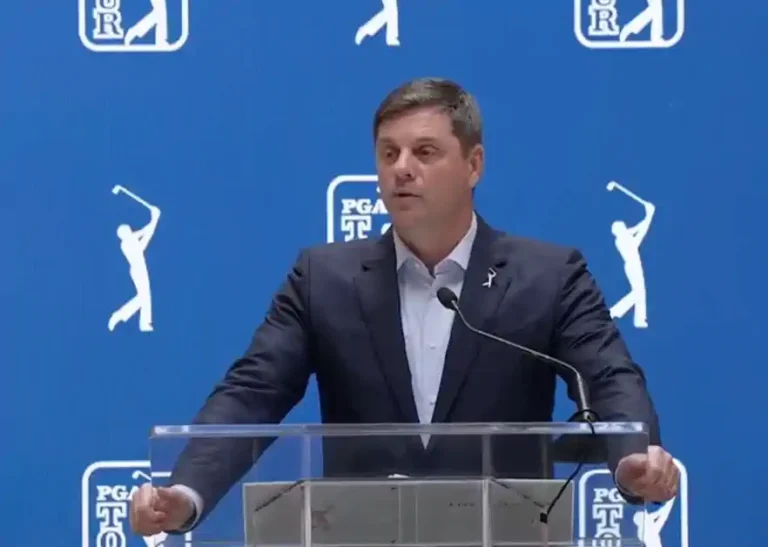
Less than a year ago, I discussed the anticipated evolution of the PGA Tour and the pivotal role its new CEO would play. So far, Brian Rolapp has given no reason to doubt his commitment to the sport I’ve loved since my teenage years.
Leading a sports league is a profound responsibility to all involved. When things are flourishing, revenue streams are robust, viewership is high, sponsors are eager, and merchandise sales are strong, it’s a time for celebration. However, the opposite can also occur, leading to disruption, especially when rival entities like LIV Golf challenge the existing structure and necessitate significant changes.
The industry is keenly awaiting June 22nd. Following the U.S. Open, the PGA Tour will head to Connecticut for the Travelers Championship, one of the elevated events. Rolapp is expected to provide an update on the future direction of this esteemed sport.
The new CEO has previously hinted at a forthcoming two-tiered system, featuring distinct series of events that may run concurrently or be staggered throughout the season. One tier will likely comprise over 20 events showcasing the world’s top players, who garner the highest earnings, viewership, and attention. The other tier is envisioned as a pathway, a feeder system for emerging talent and for players who might face relegation, though the specifics are yet to be revealed.
I’m generally optimistic about a more condensed schedule, running from January to early September, avoiding conflicts with the NFL, and featuring more high-profile events with the return of the cut format. However, the ultimate success will depend on the final execution.
As an educator in sports business, I recently brought these considerations to my students, posing a central question.
While I’m confident the premier series will retain the “PGA Tour” branding, the crucial question remains: what will the second tier be called?
Consider the NBA’s G League. Initially known as the Development League (D League), its naming rights were eventually sold. Even though players might be highly entertaining or have future potential, the league often carries a perception of lesser relevance. This distinction is acceptable because the NBA and G League are clearly separate entities, not branded under a unified “NBA Tour.” The G League typically draws between 2,500 and 4,000 spectators per game for standard franchises.
Ultimately, it all comes down to the product and how it resonates with the audience, also known as fans.
Rolapp and his team must prioritize this from the outset, potentially as early as next week. Securing the right branding for the second track or tier, whatever it may be, is paramount for its immediate success.
To his credit, Rolapp is actively engaging with players, media partners, and stakeholders. He is taking a deliberate approach to implementing this new structure. While he may not have all the answers at the Travelers Championship, he has promised an update. I anticipate that the assembled media might not press for the most challenging questions, as we all await the finalized plan, but the packaging of this new era is undeniably critical.
Tournaments I’ve come to know intimately will likely fall into this second-tier category. Major champions like Jordan Spieth and Brian Harman secured their initial victories at the John Deere Classic, and Sam Burns likewise at the Valspar Championship. These events, which once conferred PGA TOUR status and still hold significance, are essential and must be treated as such.
Perhaps the second track should be branded as the PGA TOUR “Essential” Series, as it forms the foundation for the larger structure being built. It will remain vital for players, media partners who invest in content distribution, sponsors, advertisers, vendors, equipment manufacturers, tradition, historical records, and the numerous charities that have always benefited from these community-focused events, which are now integral to the professional sports landscape.
It would be a regrettable outcome if these tournaments were to lose their importance due to impending changes.