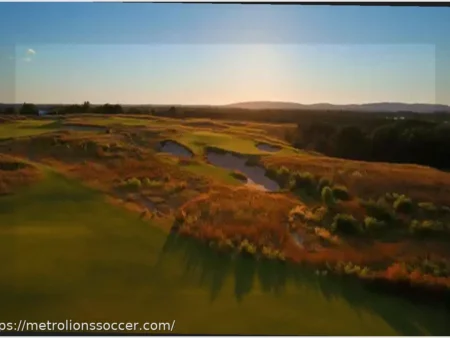
Many golf course restorations today claim to return to the original designer’s vision, but often the changes are subtle. Dunedin (FL) Golf Club stands in stark contrast. The master plan of Donald Ross, conceived in 1926 for this Florida Gulf Coast gem near Tampa, is now vibrantly evident thanks to Kris Spence’s 2024 restoration. The course, which originally opened as Dunedin Isles Golf Club, re-emerged in February 2025, showcasing Ross’s characteristic rolling greens and distinct bunker complexes, immediately recognizable to those familiar with his work.
General Manager Blair Kline emphasizes the distinction, stating, “That’s why we don’t call it a ‘renovation.’ We call it a ‘restoration.’ Ross aficionados who have been here go absolutely nuts about our greens complexes.” He confirmed that the layout remains faithful to the original, with no changes to the par designations, and that the restoration primarily focused on uncovering and revitalizing the original greens. The course saw a modest yardage increase of approximately 100 yards due to the restoration, limited by available space.
The $6.2 million project was deeply rooted in honoring Donald Ross’s legacy. This was achieved by meticulously referencing Ross’s field notes and plans discovered at the Tufts Archives in Pinehurst, N.C. However, Kline acknowledges that the restoration isn’t an “exact” replica in every sense. He explains, “Before he died (in 1948) Ross was changing the contours of a lot of his greens because they weren’t the same as the original designs. So, I have a hard time telling people that we put the ‘exact’ course out there, because I think that if Ross today saw how far the ball goes and saw the greens speeds of courses, he wouldn’t design the same golf course that’s there.”
The course, a par 72, offers a versatile playing experience with six sets of tees, ranging from 4,593 yards to 6,766 yards. “These are Donald Ross’s bunkers and his greens complexes,” Kline reiterates, highlighting Spence’s skillful execution. A key difference in the greens’ design is the intentional limitation of slope to no more than four degrees, a departure from potentially much steeper greens in Ross’s era. This adjustment, combined with modern green speeds typically around 10 to 10.5 on the Stimpmeter, creates a playable yet challenging experience.
Dunedin Golf Club, a distinguished member of the National Register of Historic Places and one of only three such courses in Florida, serves not only as a tribute to Ross’s architectural prowess but also as a prime example of successful municipal golf course ownership and operation. The City of Dunedin has owned the course since 1938. Notably, the PGA of America utilized it as its national headquarters from 1945 to 1962, during which time it was known as “PGA National Golf Club.” The course has a rich tournament history, having hosted 18 Senior PGA Championships and the inaugural “trunk” show that evolved into the annual PGA Show in Orlando. Legends like Babe Zaharias, Byron Nelson, and Sam Snead have all graced its fairways.
PGA professional Blair Kline, who has managed the club for nearly four years, was initially brought in to oversee the restoration. His current endeavors include establishing a “Donald Ross Room” to celebrate the club’s history and heritage. He notes that prior to the renovation, “There wasn’t much Ross left out there.” Kline expresses his passion for such projects, stating, “I love construction. I’ve worked on golf courses all over the country. This fits nicely into what I like.” He points out that while other Ross courses exist in the vicinity, access can be challenging, making Dunedin Golf Club a highly accessible opportunity to experience a genuine Donald Ross design.
It is a place where the master’s genius is not just preserved but actively celebrated.