For many Koreans of a certain age, the harmonica evokes cherished memories of youth and their homeland. Yet, for decades, not playing the instrument served as a quiet reminder of the past they left behind in pursuit of a new life and greater opportunities.
This is true for 80-year-old Donna Lee. Reflecting on her life, she recalls growing up in Seoul where she learned the harmonica in music class as a child. Her journey led her to immigrate to the United States, eventually settling in Southern California`s Koreatown, near downtown Los Angeles, where she still resides. She worked diligently at a local hospital for nearly 30 years before retiring.
Retirement, however, left her feeling restless and seeking more engagement. This led her to the Koreatown Senior and Community Center of Los Angeles (KSCC). The center became a place where Lee and many of her peers could attend classes and fully embrace the life they had worked so hard to build. In 2023, Lee joined the center`s harmonica class, dedicating herself and her classmates to repeatedly practicing “The Star-Spangled Banner.”
“We have weekly practice sessions, one or two hours long,” Lee shared. “We`ve done it almost every week and played it so many times I can`t count.”
Given Los Angeles`s significant Korean population, the class received invitations to perform at various local events. In January, the Los Angeles Kings hockey team reached out to the KSCC, inviting the harmonica group to perform in March as part of their Korean heritage night celebration.
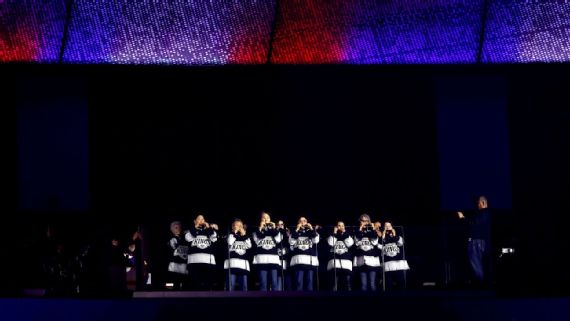
Their performance was so well-received that they were subsequently invited to perform the national anthem before Game 1 of the Kings` first-round Western Conference playoff series against the Edmonton Oilers on April 21st. Lee and 12 fellow classmates, dressed in beautiful traditional Korean clothing known as hanbok, delivered their rendition of the anthem. The performance instantly went viral online, coinciding with a victory for the Kings in that game.
“I could have never imagined that this would happen.”
The positive reception continued, leading to an invitation for the group to perform again at Game 2. This appearance further expanded their growing fanbase. The Kings also won Game 2, taking a 2-0 series lead. Since then, the group has become a true sensation, capturing attention not only within the hockey community and Southern California but also making waves back in South Korea.
In just two years, the KSCC`s harmonica class transformed from practicing the national anthem in a classroom to performing before an audience of 18,000 fans on heritage night.
That initial performance was already a highlight of a lifetime. But to receive an invitation to play at a Stanley Cup playoff game, not just once but twice? And to witness nearly everyone in the arena singing along, triggering a social media frenzy with fans demanding their return for every home game?
This kind of experience goes far beyond the sport itself, touching upon something deeply meaningful for Kwan-Il Park, a retired political journalist from South Korea who now serves as the KSCC`s executive director.
“There haven`t been many opportunities where the Korean community and the mainstream community could truly come together in this way,” Park explained through interpreter Sandra Choi, a KSCC volunteer. “The crucial point here is that the harmonica is not an expensive instrument. It`s just $15 or $20 – an everyday instrument accessible to everyone.”
Park highlighted that the ability to perform the national anthem using such a universally approachable instrument created a moment where the group felt fully immersed in their cultural identity while simultaneously honoring the country they have called home for many years.
“We`ve often been perceived as outsiders, immigrants facing cultural and language barriers,” Park stated. “You come here and work tirelessly for 30 or 40 years. This time, we had the chance to stand shoulder-to-shoulder as Korean Americans, not just immigrants, and perform in front of 20,000 people? I honestly don`t even have the right words for that feeling.”
Park mentioned that Koreans first began immigrating to the U.S. in 1903, often settling in Pacific coast cities. Following the Korean War in the 1950s, a second wave significantly contributed to the current demographic landscape, with nearly 2 million Koreans residing in the U.S. today.
While cities like Chicago, New York City, and Washington D.C. have notable Korean populations, Los Angeles boasts the largest, with 17% of all people of Korean descent in America living there.
But what makes playing the national anthem on a harmonica particularly special? It`s how the instrument serves as a bridge, connecting the life they once knew with the life they came to build for themselves and future generations.
Yong-Sin Shin, the KSCC chairperson, shared that a particular generation of children growing up in South Korea were introduced to the harmonica in second grade music class. While some continued playing for a few years, many stopped after immigrating to the U.S.
For the group at the KSCC, the harmonica became a way to reconnect with those earlier times.
Sandra Choi commented that for many older Koreans, playing the harmonica offered a rare chance to relax, something not always available to a generation that dedicated years to working and supporting their families.
“We would often find a harmonica in my house because my dad had one,” Choi recalled. “When he played it, it somehow touched the soul of my childhood as a Korean American. Even though I`m not from Korea, the tone and the songs we play on it create a connection for all of us.”
Shin explained that the KSCC was founded with the goal of providing a sense of community for older generations of Koreans, offering classes to enrich their lives in their later years.
Initially, the center offered five classes per week. Since then, it has expanded significantly, now providing 47 classes every Monday through Friday, attracting nearly 1,500 people weekly.
These classes cover a wide range, from developing practical daily skills to engaging in hobbies. For instance, the KSCC offers multiple levels of English classes and beginner and intermediate classes for learning smartphone use.
However, perhaps the most celebrated offering in the KSCC curriculum is the 11:10 a.m. Wednesday harmonica class, lasting 50 minutes.
Shin noted that the harmonica class began in 2021. Initially, the group practiced for weeks to gain confidence before performing in public. They started performing at events like Mother`s Day, Thanksgiving, or Seollal (Korean Lunar New Year in February). The class`s profile grew notably when they were invited to perform at Los Angeles City Hall in 2023.
“Our senior harmonica class performed in front of about 100 people there, and everyone loved it,” Shin said. “So, we continued to perform at our center`s events, they got better and better, and we started receiving more invitations to play.”
A point consistently emphasized by Park, Shin, and Choi (even outside her interpreter role) is the sheer unexpectedness of the harmonica class`s performance and the rapid popularity it gained.
Truly, nobody saw this coming.
“I have a child in high school, and she even showed me the clip because it was so viral,” Choi recounted. “She said, `Isn`t this where we volunteer?`”
Part of the surprise stems from the performance platform. It`s difficult to find a video of the group`s first performance for the Kings, likely because it was during the regular season.
Contrast that with the playoffs, where the national anthem was televised across North America.
Certainly, anthem performers often receive attention. But when it`s a group of a dozen or so elderly Korean citizens performing – with harmonicas? Such a distinctive act was destined to capture attention both within and beyond the sport.
And it did. The result was an invitation back for Game 2, but this time, instead of traditional Korean attire, they donned Kings jerseys. They also faced higher expectations now that a wider audience knew what to anticipate.
Their performances sparked numerous social media comments, ranging from humorous takes like “Oilers comeback bid was cool but you ain`t beating the Kings in the house that the Korean Harmonica Grannies built” to a rival Oilers fan asking, “Does anyone in the Edmonton Korean Community play Harmonica? We need to fight fire with fire here.”
“We weren`t nervous,” Lee said about herself and her classmates. “It was my first time visiting the arena, and it was because of the performance. So many people seemed surprised, and we simply enjoyed the wonderful atmosphere of the big place filled with many people. We felt our performance went well, thanks to all our preparation and practice for the national anthem.”
Lee mentioned she had never watched a Kings game before but made a point to stay for Game 1 and immediately became a fan. Some members of the class stayed to watch, while others headed home.
But now?
“We`re all L.A. Kings fans now!” she declared with a laugh.
Lee and Park shared that they have heard from family and friends in South Korea about how their performance made headlines there. This was another unforeseen outcome, further enhancing the visibility of Korean culture.
The Kings joined other major Los Angeles sports teams, including the Lakers, Dodgers, and Clippers, in hosting a Korean heritage night. Both the Rams and Chargers have also promoted initiatives during Asian American and Pacific Islander (AAPI) Month.
This moment also aligns with the broader trend of Korean food, film, music (K-pop), and television (K-drama) gaining significant traction in the mainstream.
“We have K-pop, K-drama, K-food, K-beauty,” Lee summarized lightheartedly, “and now we have K-seniors!”